Toyota’s new Land Cruiser FJ arrives with heritage in its bones and a younger buyer in its sights, blending retro charm, real off-road ability and the weight of one of motoring’s most trusted names

What’s in a name? Well, unrivalled local interest when that name starts with ‘Land’ and ends with ‘Cruiser’. But also – and most importantly in the context of the current state of the motoring industry – a name holds heritage, and heritage holds a promise. Globally, the motoring industry has been saturated by Chinese manufacturers, and in South Africa, the influx from the East cannot be ignored. While these vehicles score points in short-term value, you’d be hard-pressed to find any soul in the samey designs that have begun to dominate the roads, and the technological gimmicks that decorate the spec sheets.
Halfway through 2026, Toyota’s Land Cruiser FJ hit South African shores. While the FJ name tag is familiar, Toyota has emphasised that its newest Land Cruiser is not a direct successor to the V6-powered, rear-suicide-doored FJ Cruiser manufactured and sold in South Africa from 2002 to 2022. Instead, the name pays homage to the iconic FJ40, produced from the ’60s through the ’80s, and widely regarded as the spiritual ancestor of all modern Land Cruiser SUVs.
I couldn’t help but hope, listening to a presentation about Toyota’s latest Land Cruiser in a meeting room at the Canopy Hotel in Cape Town, that this nod to the past would be, in equal parts, a promise to the future.
Before we could test the qualities of the latest ladder-frame to roll off Toyota’s production line, we enjoyed an evening stay at the Canopy by Hilton Hotel in the newly developed Longkloof precinct. The quirky accommodation, located just off Cape Town’s popular Kloof Street, mirrors the vibrance of the city: atmospheric, eccentric and modernised, but not at the expense of any soul.
 ONGETEM restaurant, the latest culinary masterpiece from celebrated South African Chef Bertus Basson, lives on the ground floor of the Canopy. After the presentation, we enjoyed what is better described as a banquet than a dinner. Small plates of flavour-filled variety, wood-fired flatbreads and slabs of Frankie Fenner Meat Merchants steaks arrived on the table in such volume that plates began spilling over to side tables to accommodate whatever interesting course came next. It was one of the best meals I’ve had in 2026.
The fleet of Land Cruiser FJs, finished in ‘Platinum White Pearl’, ‘Attitude Black’, ‘Ash Grey’, ‘Calcite Blue’, and ‘Oxide Bronze’, stood out against an overcast Cape Town winter morning. We picked our chariots and rolled out of the city, retro-styled front ends pointed towards Riebeek-Kasteel, one of South Africa’s oldest towns, situated in the Swartland municipality, held by hectares of vineyards and mountain-filled horizon lines.

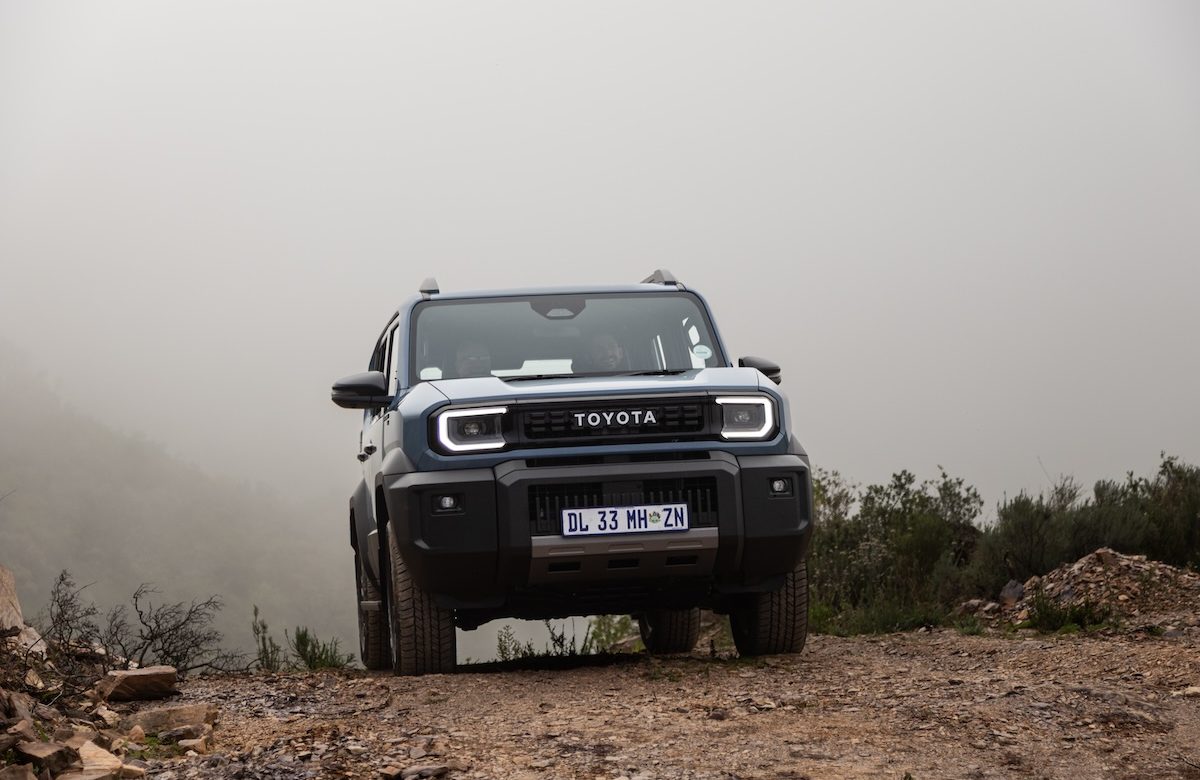
Toyota calls the Land Cruiser FJ’s design language ‘Playful Dice’ – a chamfered square body, short overhangs and an upright stance that deliberately nods to the FJ40 of the ’60s and ’70s. The front echoes the current Prado’s bold face, with a TOYOTA heritage grille, high-mounted square LED headlamps and segmented bumpers designed for field repairability. Strong horizontal lines, flared fenders and a rear-mounted spare on a side-opening tailgate complete a purposeful, distinguished silhouette. The convoy certainly stood out as we made our way north.
South Africa has long been one of the most loyal Land Cruiser markets, and it was noted at the launch that the country sits in the top 10 global markets for the Land Cruiser brand. Also emphasised at the launch was which market the latest iteration of the iconic name aims to capture. The Land Cruiser FJ, priced well below its bigger siblings, appeals to the young professional wanting to buy into the Land Cruiser family at a more achievable price point. With both 2 x 4 and 4 x 4 models, the FJ meets the multi-terrain needs of an urban and off-road vehicle, and bridges the gap between the brand’s popular portfolio of crossover SUVs and fully fledged, locally revered SUVs in the Land Cruiser 300, Land Cruiser 70, Prado and Fortuner.
 Under the boxy skin is Toyota’s IMV 0 ladder-frame platform – a shortened version of the same architecture that underpins the current Hilux and incoming Fortuner, extensively braced and stiffened specifically for SUV duty.
The FJ rides Toyoat’s IMV 0 ladder-frame platform – a shortened, SUV-specific variant of the architecture beneath the Hilux and incoming Fortuner. Power comes from the 2TR-FE, a 2.7-litre naturally aspirated four-cylinder producing 122 kW and 245 N·m, paired to a six-speed automatic. Part-time 4WD with low-range and a locking rear differential are standard across both grades. A diesel – likely the 2.8-litre GD-6 – is widely anticipated but unconfirmed, and its absence remains the one recurring criticism of an otherwise well-received package.
The quiet route up the N7 presented more than enough time to get a feel for the driving experience. The road north out of Cape Town soon trades the sprawl of the city for open wheat fields and the low mountains of the Swartland. This unhurried drive rewards an early start. The FJ is more composed on tar than its proportions might suggest, and there is none of the top-heavy nervousness the tall, square profile might lead you to expect. The 2.7-litre naturally aspirated petrol pulls the vehicle to respectable highway speeds, but it is not a quiet achiever getting there. The engine is vocal under load, and the absence of low-down torque is felt. The six-speed automatic is unobtrusive, and ride quality is settled enough for daily use. As the landscape opened up ahead, there were few complaints from behind the wheel. The low-set dashboard affords good outward visibility, a practical consideration both in traffic and on the trail.

The cabin makes a strong case for itself, with well-chosen materials throughout. The driving position is easy to find, outward visibility is good, and there is genuine space for passengers front and rear. Wind and road noise are well suppressed, completing a cabin that is generally a nice place to be.
We turned off the tar at Kloovenburg Estate, one of the oldest-registered properties in the area. Established in 1704 and owned by the Du Toit family since 1956, Kloovenburg sits at the foot of Kasteelberg on the edge of Riebeek-Kasteel, about an hour north of Cape Town. The estate produces Swartland-focused wines alongside estate olive oil, and has grown into a destination in its own right – wine and olive tastings, retail, accommodation and dining draw a steady stream of visitors making the trip out from the city. We took our final lunch at Eight Feet Village, the estate’s dining outpost perched atop the Bothmaskloof Pass. Built largely from repurposed shipping containers, it is an unpretentious spot with a deli counter, a long bar and unobstructed views across the valley below – this stop alone justifies the drive. Beyond the food and the view, the private farmland would host our fleet of FJs as we put their off-road credentials to the test.

Any vehicle bearing the Land Cruiser badge comes with high off-roading expectations, and the FJ impressed on the test route. The dimensions, shorter wheelbase and tighter turning circle are notable off-road assets, handy as we manoeuvred the convoy up and down the narrow mountain paths with relative ease. A locking rear differential and low-range transfer case are standard across both grades, and it is evident that the off-road brief was taken seriously from the outset. Therein lies the quiet appeal of a vehicle like this: it grants you the adventure in the first place. So much of the Western Cape’s beauty isn’t found on the highway but at the end of a gravel track, over a mountain pass, or down a farm road that leads somewhere most never see. The best of this part of the country rewards those willing to leave the tar behind – and a trip out here is all the better for it.

The Land Cruiser FJ may divide opinion in South Africa until a date is set for the diesel offering, but it is undeniably a well-packaged product and a statement of intent from Toyota, continuing the legacy of the Land Cruiser to a new generation, whose needs and wants might differ slightly from those of the older SUV owner. With the release of the Land Cruiser FJ, Toyota has chosen to embrace contemporary demands – both stylistically and functionally – while holding onto tradition in equal measure. In the face of a mass homogenisation of style across the motoring industry, it’s a bold and welcome move. Hopefully, one that keeps the spirit of adventure front of mind for a new generation of buyers.
Toyota Land Cruiser FJ 2.7 at a glance
- Price: R714,000 (GX) – R761,400 (VX)
- Engine: 2.7-litre NA 4-cyl petrol, 122kW/245Nm
- Transmission: 6-speed auto, part-time 4×4, low-range
- 0-100km/h (tested): 12.47 seconds
- Braking (tested): 3.01s / 42.69m
- Fuel (tested): 12.2L/100km
- Weight: 1,985kg
- Dimensions: 4,610mm L, 1,855mm W, 2,580mm wheelbase
- Ground clearance: 245mm
- Warranty/service plan: 3-year/100,000km, 9-service/90,000km