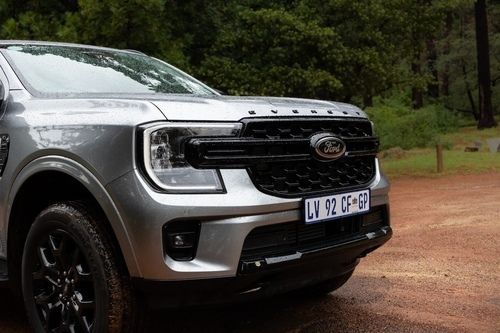
We’ve driven the Ford Everest Sport 4×4 through the tail end of summer and into the start of a wet Cape Town winter. Over three months, the seven-seater SUV proved itself to be a refined, stylish daily companion with the bonus of a serious off-roading pedigree.

The Everest Sport occupies an interesting space in the Ford line-up; not as plush as the Platinum or as aggressively styled as the Wildtrak, it serves a sweet spot for buyers who want understated style, space for the family, and legitimate 4×4 hardware without creeping too far past the R1-million mark.
From March to June, the Everest Sport settled into a daily routine of short city trips – handled with a level of refinement that defies its ladder-frame underpinnings. It remained impressively quiet and smooth, thanks largely to the bi-turbo diesel engine’s linear torque delivery and a crisp 10-speed automatic gearbox.
Related: Ford Everest Sport 4×4: Long Termer Introduction – Leisure Wheels
Fuel consumption has stayed consistent, hovering around 10.6L/100km in mostly urban driving, up from the 9.2L/100km noted in month one. Given Everest’s size and weight, the hills that characterise my area in the city, and the occasional ventures onto gravel, that figure feels acceptable. Ford claims a combined figure of 7.5L/100km, but one would struggle to attain living in the city and doing short trips.

As everyday road manners go, the Everest Sport behaves like a premium SUV, but doesn’t bluff about its off-road credentials. Underneath the slick Aluminium Metallic paint and gloss-black 20-inch wheels is a serious 4×4 system.
Selectable high and low-range modes are engaged via a rotary dial, and an electronic rear differential lock comes in handy for tougher conditions. While our off-road testing hasn’t included anything as technical as the passes popular to South African adventurers, the Everest proved more than capable on extended gravel routes in the Cederberg, confidently handling load, passengers, and mixed surfaces. Suspension damping remains a highlight — soaking up washboard corrugations without the usual ladder-frame shake, while the light all-terrain tyres keep things composed.
Ford’s approach and departure angles are respectable, particularly for a vehicle that still looks sharp on an urban strip. Approach angle is 30 degrees, and the departure angle sits at 25.6 degrees (dropping slightly to 23 degrees with a towbar fitted). And while the Everest doesn’t get the 4A automatic all-wheel-drive mode found in the Wildtrak or Platinum, the Sport’s part-time system still allows for more than enough control over variable conditions.
In off-road theory, as Ford explains, “as slow as possible, as fast as necessary” is the golden rule — and the Everest’s throttle control, low-end torque and hill descent capabilities inspire confidence for the novice and the experienced off-road driver.

The Everest Sport is well balanced in terms of practicality and comfort. The cabin layout is logical and spacious, with the seven-seat configuration proving useful for both people and gear. The second and third rows fold easily to accommodate larger loads, and everyday usability is enhanced by features like the 12-inch touchscreen (running SYNC 4A), wireless Apple CarPlay, and thoughtful touches like USB ports in all the right places.
Unlike some overly digitised new models, the Everest still has a welcome number of tactile buttons for essential functions, and Ford’s approach to safety tech feels calibrated rather than aggressive. Lane-keeping assist and blind-spot monitoring are helpful without being intrusive, and features like the 360-degree camera make parking this near-five-metre SUV surprisingly easy.
Related: Ford Everest Sport 4×4: Long Termer Update – Leisure Wheels
Three months is a nice amount of time to familiarise oneself with a vehicle and step into a potential owner’s shoes. The overriding experience in those three months with the Everest Sport was positive. The seven-seat configuration makes it a wonderful family vehicle, though I tested this with friends rather than children! But adding to its practical selling points are its ability to switch between urban commuter and serious off-roader.
The Everest Sport, without getting lost in the sometimes superfolous features that find their way into luxury vehicles, delivers on what matters: comfort, space, performance, and a genuine ability to escape the city and be comforted in capability in tricky conditions. Equipped with a well-engineered 4×4 system, the Sport presents as both a fun car for the adventure-focused individual and a safe vehicle for families looking to take on tougher trips.

FORD’s Top Tips for a Safe and Enjoyable Off-Road Experience
With their extensive range of 4×4-capable vehicles, Ford is committed to equipping buyers with the knowledge and skills to use them. Here is the basic functioning of their drive systems explained:
Available on certain Ranger derivatives such as the Tremor, Wildtrak and Platinum is an on-demand four-wheel drive system with 2H, 4A, 4H, and 4L. This allows the Ranger to be driven in four-wheel drive on high-traction surfaces via its 4A (automatic) mode. When selected, the system continuously distributes power between the front and rear axles for optimum performance in all on-road conditions. There’s also a two-wheel drive (2H) mode which disengages the front axle for rear-wheel drive only. The 4H setting locks power 50/50 between the front and rear axles while 4A engages four-wheel drive automatically when needed. In normal driving conditions, it acts like 2H (two-wheel drive), but when it senses wheel slip, it sends power to the front wheels. The 4H setting is great on gravel roads, sand, mud, or moderately rough terrain while 4L provides extra torque at lower speeds and is suited to steep hills and rocky terrain. *The Everest Sport 4×4 has 2H,4H and 4L, but not 4A.
Modern 4x4s often come equipped with advanced technology like Hill Descent Control and Terrain Management Systems. Certain Ford Everests and Rangers are fitted with a Drive Mode selector via the rotary dial, comprising Normal, Eco, Tow/Haul, Slippery, Mud/Ruts, Sand and Rock Crawl. The system automatically adjusts the throttle response, gearshifts, traction and stability control, as well as the steering and braking system to optimise vehicle performance to suit the terrain depending on the mode selected. 4×4 Ranger and Everests feature an electronic rear-differential lock which can be activated via the SYNC® screen or by the centre console button. A differential lock allows both wheels on a specific axle to turn at the same speed, providing additional traction when you’re off-roading.
Related: How to Read a 4x4 Tyre Sidewall: Complete Guide
View this post on Instagram